
A guardian for future generations
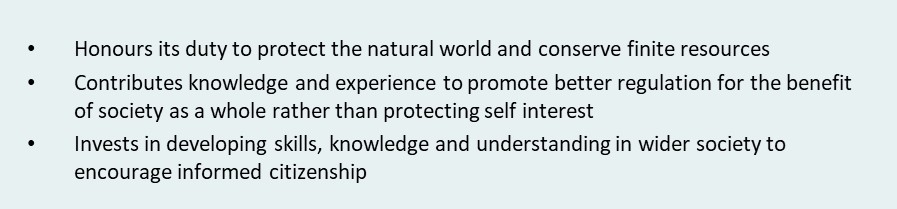
This principle acknowledges a duty towards future generations. A business cannot successfully pursue a worthwhile purpose in a society or environment that is failing.
- A true commitment to benefit society will prompt a business to use its agency in the system in a positive way for the benefit of all.
- This stewardship ethos goes beyond what we can control and encourages us to contribute to what we know needs to be done and contribute what we can to solving problems of people and planet such as social fragmentation, the impact of new technologies and innovations and climate change.
- Being a guardian for future generations requires a company to recognise the power and knowledge it accumulates and has, and to use it not for its own advantage but for the long-term interests of society and its future generations. For example: lobbying efforts to weaken regulation to benefit short-term interests of a business to the detriment of society or to influence regulation to be a barrier to competition that could be in the long term interests of society.
- Stewardship is more than risk mitigation and conservation. It is about the business looking at the broader impact of its activities and about recognising and using the business’ agency in the system to promote changes, including through collective action where it has knowledge, influence and capacity to do so. Especially at a time when the world is facing such acute systemic challenges both environmentally and socially, exercising such choices intelligently and courageously characterise purpose-led businesses.
How can a business be a guardian for future generations?
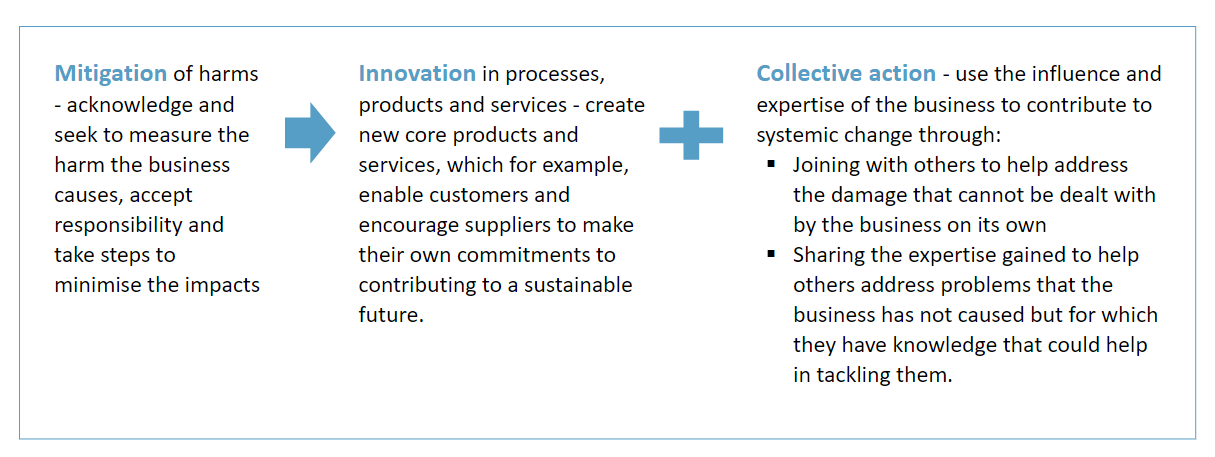
The behaviour shift described in the Framework is particularly clear in this area, where a mindset of self-interest (using, extracting and depleting resources) shifts to one of seeking to develop people and replenish resources, using the agency of the business in the system to advance the common good of society.
So it involves the following shift:
One example of how a business can use its agency and influence to contribute to systemic change is to engage with industry an other associations. In this article Unilever’s Head of Sustainability calls on industry associations to step up on climate efforts Why industry associations need to step up climate efforts | Unilever
Invests in developing skills, knowledge and understanding in wider society to encourage informed citizenship
- A critical society is a healthy society, and a healthy and democratic society enables healthy, prosperous, and sustainable business.
- Businesses can create environments and encourage relationships that help cultivate people’s ability to think critically, question and challenge. Democratising decision making, contributing knowledge, learning and skill development, enabling and welcoming constructive dialogue, respecting differing opinions and avoiding blame or polarised arguments all help in developing engaged citizenship and a democratic society. Businesses can also promote healthy work practices that encourage deep thinking and reading by limiting distractions.
- A good example of how businesses influence citizenship in an age of technology is the unintended consequence of digital platforms and how the constant information flow has an adverse impact on people’s attention. This has consequences on the ability to develop critical thinking skills and to comprehend the complexity of thought and argument and has a direct impact on the company’s productivity and creativity, and an indirect impact on citizenship.
- In this area, we need also to note the limits of what any business can or should be expected to do. There is a vital role for government and regulation, with the democratic accountability those have, to address a range of collective problems in society. Businesses have a role, but also have to be careful not to stray beyond their mandate and use their power and influence to seek to influence society in areas unrelated to the business itself.