AI and the future we choose

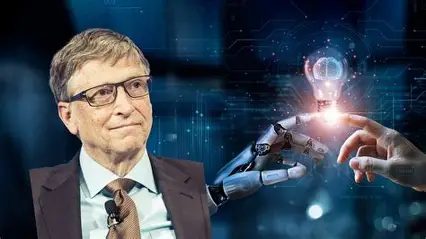
The most important question about AI is not whether it becomes more powerful. It is whether we become wise enough to direct that power towards human flourishing.
In his recent essay, Bill Gates argues that we are entering a turbulent AI era and that “the choices we make now are critical“. He suggests that artificial intelligence will affect society more deeply and more quickly than previous technological revolutions, bringing both extraordinary opportunities and profound risks.
The debate has moved beyond whether AI will transform our economy and society. It already is. The more important question is what kind of future those transformations will create and who gets to shape them.
Gates suggests “The solutions should be shaped by our answers to the profound questions raised by AI, including how we preserve our humanity in a time when machines can out-think us.”
While much of the current conversation focuses on adoption, productivity, risk and regulation, we believe there is a more fundamental question that leaders should be asking: What is the role of our business in building a better future, and is the way we are thinking about the deployment of AI consistent with that?
This transition really is different
Throughout history, societies have adapted to transformative technologies. From mechanisation to electricity to the internet, innovation has changed how we live and work.
But Gates argues that AI is fundamentally different because it can increasingly substitute for human cognitive work itself. Unlike previous technologies, AI can learn from us, communicate in natural language and be adopted rapidly across almost every sector simultaneously.
If this transition is fundamentally different, our decision-making frameworks need to be different too. Efficiency, productivity and compliance are not sufficient guides for a technology that reshapes work, relationships, education and our understanding of human value.
Beyond jobs: the question of human purpose
One of Gates’ greatest concerns is the effect AI may have on employment. He warns that both white-collar and blue-collar jobs could be disrupted at a pace faster than previous industrial transitions, with young people particularly vulnerable as entry-level opportunities diminish.
Much of the public debate focuses on the economic consequences of this disruption.
But there is a deeper question.
What if the real issue is not only income, but meaning?
Too often work is discussed purely as a mechanism for earning a living. Yet work also provides something more fundamental: dignity, purpose, identity, connection and contribution. It gives many people a sense of belonging and a way to participate meaningfully in society.
This is why discussions about a future of abundant automation cannot be reduced to economics alone. We need to ask what forms of human contribution we value and what role work should continue to play in helping people flourish.
Gates touches on this through his idea of “Human Reserved” domains, suggesting there may be areas where society intentionally chooses to keep human involvement at the centre even when machines could technically perform the task. Caregiving, education, counselling and moments requiring empathy and understanding may be among them.
That feels like an important conversation we need to start having now.
Moving beyond efficiency
Perhaps the most significant challenge facing business leaders is that many AI decisions are currently being driven by a single objective: efficiency.
The temptation is understandable. Organisations face intense pressure to reduce costs, increase productivity and keep pace with competitors.
Yet history reminds us that technologies shaped solely by efficiency can create unintended harms.
Our framework for using AI suggests that organisations tend to approach AI from one of three mindsets: an efficiency mindset, a risk mitigation mindset, or a genuinely human-centred mindset. The challenge is not simply to minimise harm but to actively ask how AI can contribute to human flourishing, trusted relationships and the common good.
This requires moving beyond the question: can AI do this? to the more important questions:
- should AI do this?
- will it strengthen or weaken human capability?
- will it build trust?
- who benefits and who bears the cost?
These are not technical questions. They are leadership questions.
Governance matters, but values matter too.
Gates calls for new institutions and governance frameworks to help society navigate the transition. He argues that the scale and speed of AI’s impact will stretch existing structures beyond their limits and require new forms of national and international coordination.
This is important and necessary. But governance alone is not enough.
Regulation can establish boundaries. It can help determine what organisations are permitted to do. But it cannot tell them what they are here to do.
Long before laws catch up, countless decisions about AI deployment will already have been made in boardrooms, procurement teams, product development processes and investment committees. Those decisions will be guided not by regulation but by underlying assumptions about people, value and what the organisation considers as success.
That is why organisations need a clear philosophy as well as clear governance. They need principles that place human dignity, the common good and stewardship at the centre of decision-making.
Protecting human agency
Among Gates’ concerns is the possibility that AI could weaken critical thinking, deepen dependency and replace important human relationships. From education to companionship, he argues that we must think carefully about what is gained and what may be lost as machines become increasingly capable.
This points to another vital principle.
The measure of successful AI adoption should not be how much thinking humans stop doing – it should be how much human capability AI helps unlock.
At its best, AI can help doctors spend more time with patients. It can support teachers to focus on individual students. It can help workers navigate complexity and free people from routine administration. Gates highlights significant opportunities across healthcare, education, agriculture and public services.
The goal should not be to make people passive recipients of machine intelligence. It should be to help people exercise better judgement, retain agency and realise more of their potential.
The future is not inevitable
One of the most encouraging aspects of Gates’ essay is that it rejects technological determinism. The future is not something that simply happens to us. It is shaped by the choices we make.
The same is true for business.
The organisations most likely to thrive in an AI-enabled future are not those that adopted AI fastest. They are those that adopted it most thoughtfully: with a clear sense of what they were for, genuine attention to the people affected, and the foresight to shape the technology around their values rather than letting the technology shape them.
AI’s future is still being written.
The critical question is not whether AI will become more powerful. It almost certainly will.
The critical question is whether we use that power to create a more productive society or a more flourishing one.
That choice remains ours. And, as Bill Gates rightly argues, the time to make it is now.