Who gets to shape the future of AI? Reflections from the Deeply Human Summit

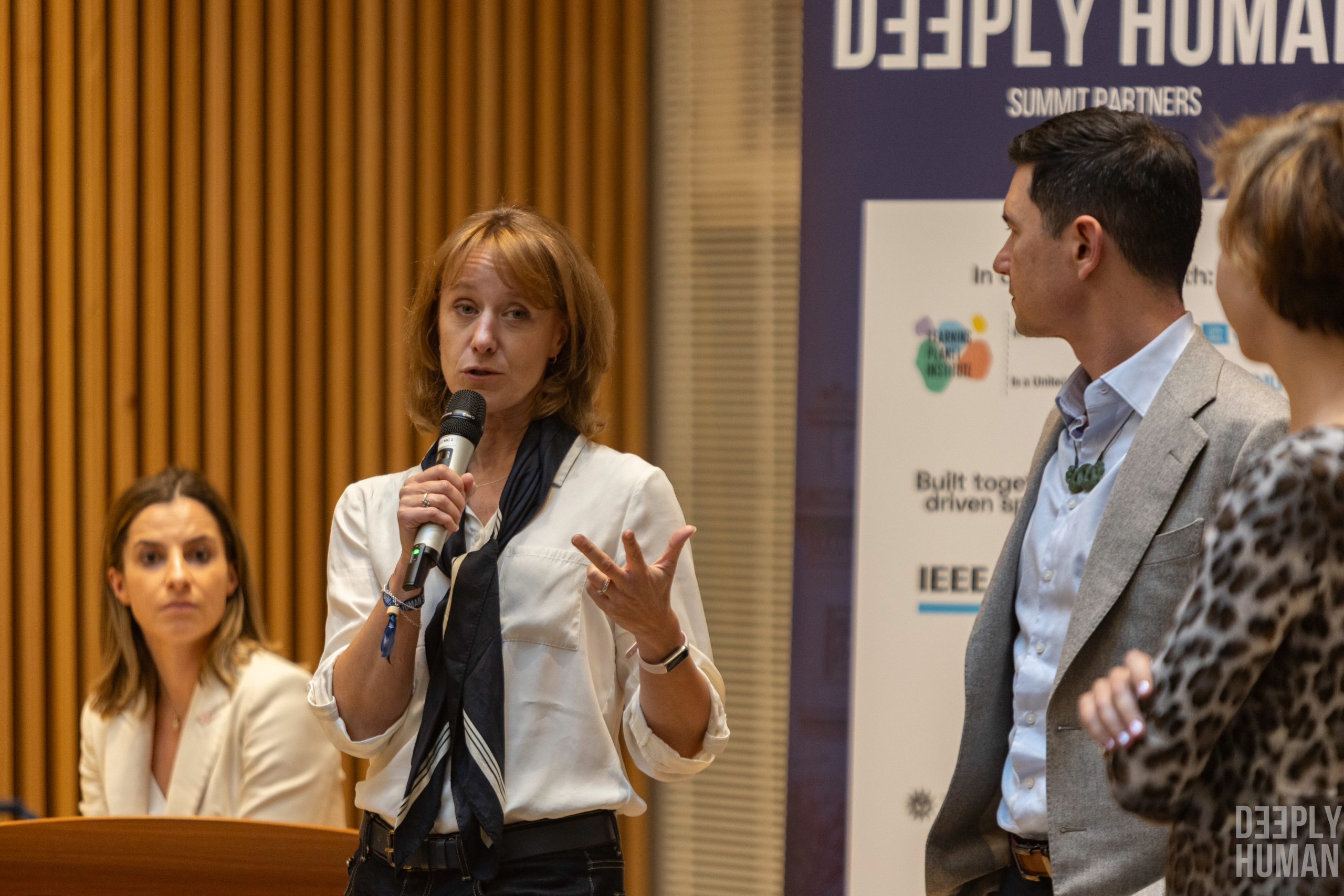
Reflections from our CEO, Sarah Gillard, following her attendance at the Deeply Human Summit in October 2026.
I recently attended the Deeply Human Summit in Paris, which brought together people from across technology, policy, academia and civil society to explore how we might shape an AI-enabled future that keeps people and planet at its heart. What stayed with me most was not a particular technological development, but a more fundamental question – who gets to participate in imagining and shaping our collective future?
One of the most powerful aspects of the Summit was the prominence given to youth perspectives. Ahead of the gathering, young people from around the world, including my own daughter (!), were invited to share their hopes, concerns and ideas about the futures they want to build with AI. These perspectives opened the Summit and became a reference point for conversations over the following two days.
For me, this brought Plurality, one of the principles within Blueprint’s framework for human-centred AI, into sharp focus. Plurality recognises that there is no single definition of a good life, a good society or a desirable future, and that different experiences and perspectives need meaningful opportunities to shape the decisions we make. This feels particularly pertinent in the context of AI and future generations, when we are increasingly witnessing those who will live longest with the consequences of decisions being made today being too often absent from the conversations shaping their future.
From youth voice to youth agency
I was inspired by the nuance of what I heard from the young people themselves. They were not simply asking us to “embrace” or “reject” AI. Among the themes that stayed with me were a desire for AI to help people develop their own skills rather than eroding human capability; for its development to contribute positively to planetary health; and for AI to remain distinct from humans rather than seeking to replicate human identity.
Underlying those concerns, however, was something more fundamental: young people wanted to “retain the capacity to keep shaping what comes next”, and for that future to remain plural.
I think that distinction between voice and agency is important. Meaningful youth inclusion cannot simply involve asking young people for their views and then returning to established ways of making decisions. It requires us to recognise that they have a legitimate stake in those decisions and to preserve their ability to influence how our choices evolve.
Another question I noted down during the Summit captured the tension particularly well. François Taddei asked, in thinking about the future: “Is your dream somebody else’s nightmare?”
It is a deceptively simple question, but an important one in the context of AI. There is no single version of what a good AI-enabled future should look like. Different generations, communities and cultures bring different understandings of what matters, how we should relate to one another and what role technology should play in our lives. If the development and deployment of AI progressively narrows that plurality towards a single vision of progress, we risk losing something fundamental: our capacity to imagine and create different futures.
Rethinking how we measure progress
One of the other things I came away from the Summit particularly interested in was how we might measure the impact of AI differently. A fascinating example is MIT Media Lab’s ImpactBench, an open benchmark for measuring AI’s impact on human wellbeing across psychological, physical and social dimensions.
Most AI benchmarks focus on capability and how accurately a model performs, how well it reasons or whether it can complete a particular task. In contrast, ImpactBench has a different departure point – it focuses on understanding how an AI system may support or undermine human flourishing. It considers areas such as agency, learning, creativity, judgement, social relationships and wellbeing, asking whether AI supports people’s capabilities and connections or risks diminishing them.
It also translates this thinking into an AI Nutrition Label, designed to provide an accessible summary of the beneficial behaviours a model promotes and the harmful behaviours it avoids.
I find this compelling because it changes the terms of the conversation. Rather than asking only, “What can this technology do?”, it encourages us to ask, “What is this technology doing to us?” For businesses making decisions about AI, the second question may ultimately be just as consequential as the first.
Keeping the future open
I left the Deeply Human Summit feeling hopeful, in large part because the conversations did not treat the future of AI as predetermined. As Marshall McLuhan’s observation, also referenced at the Summit, reminds us: “We shape our tools and thereafter our tools shape us.”
That relationship works in both directions. The choices we make about AI today will shape how these technologies influence our capabilities, relationships and institutions. But we still have choices about the technologies we create, the measures of success we apply to them, and the voices we include in making those decisions.
Young people are not simply asking the current generation of decision-makers to build the right future on their behalf. They are asking to participate in imagining and shaping it themselves. For those of us working across business, policy and civil society, the challenge therefore goes beyond simply listening. It is about preserving the conditions in which different generations, communities and perspectives can continue to influence what comes next.
Perhaps that is one of the most important things plurality can offer us in the age of AI: not a single vision of a good future, but a commitment to preserving our collective capacity to imagine, debate and continue shaping different ones.
Sarah Gillard, CEO